

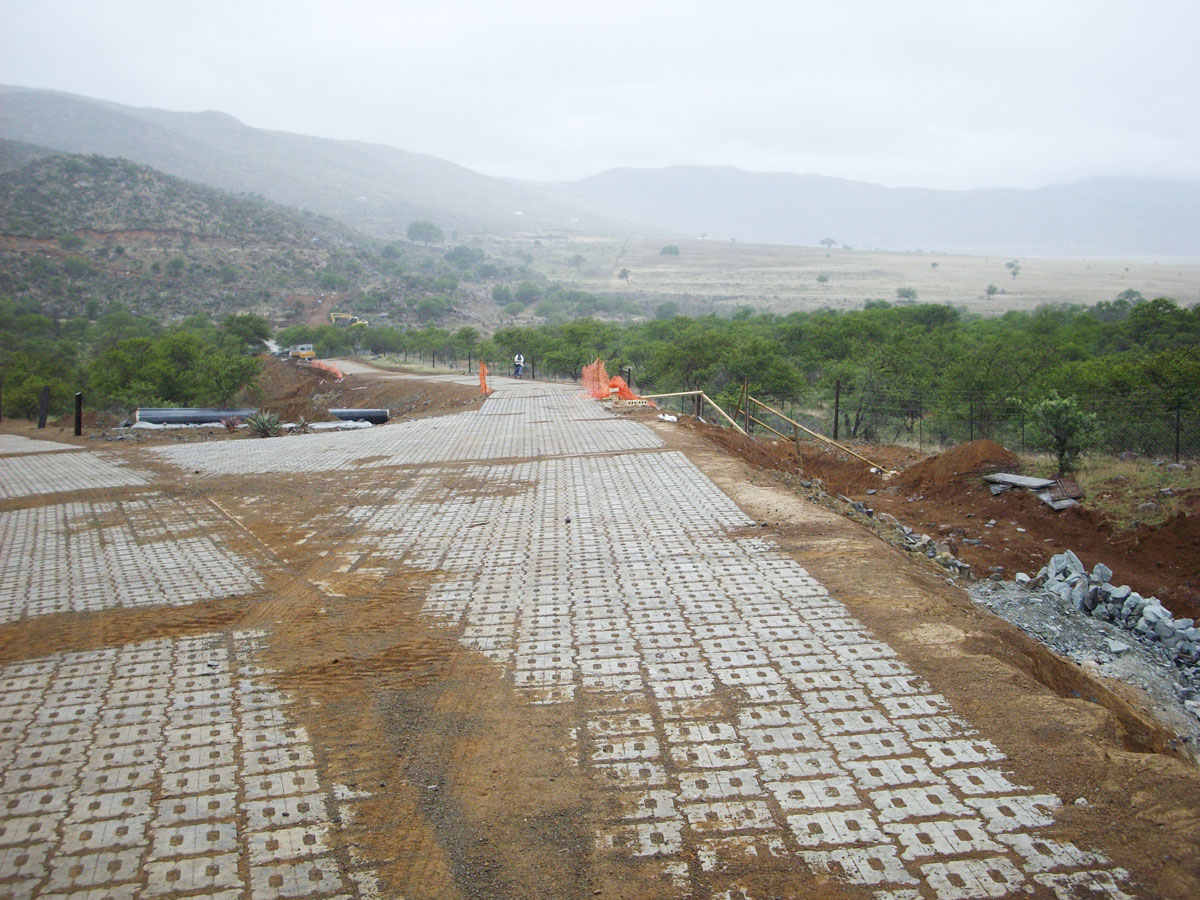
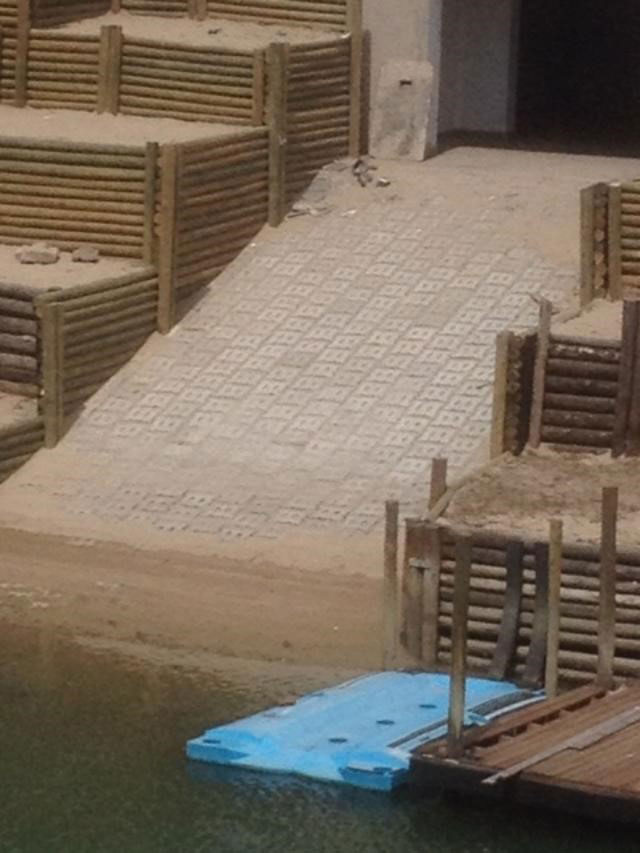
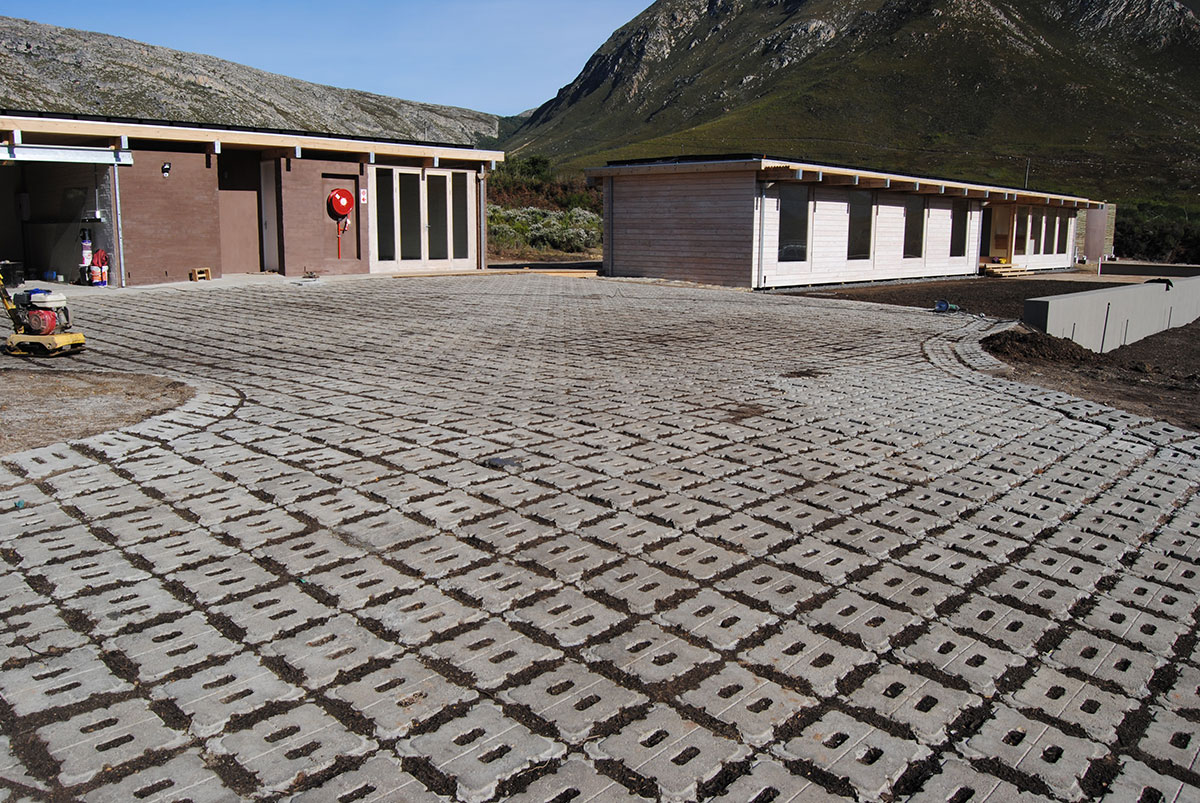
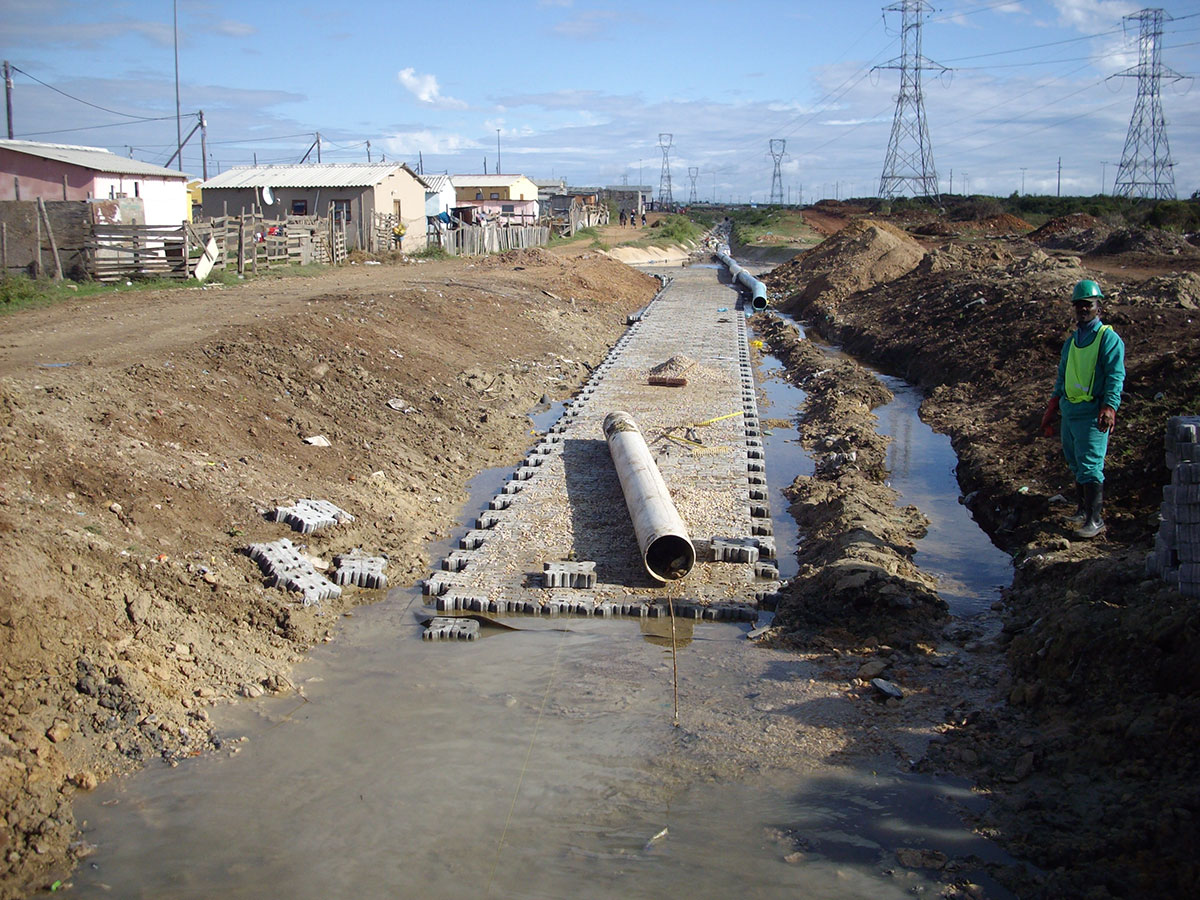


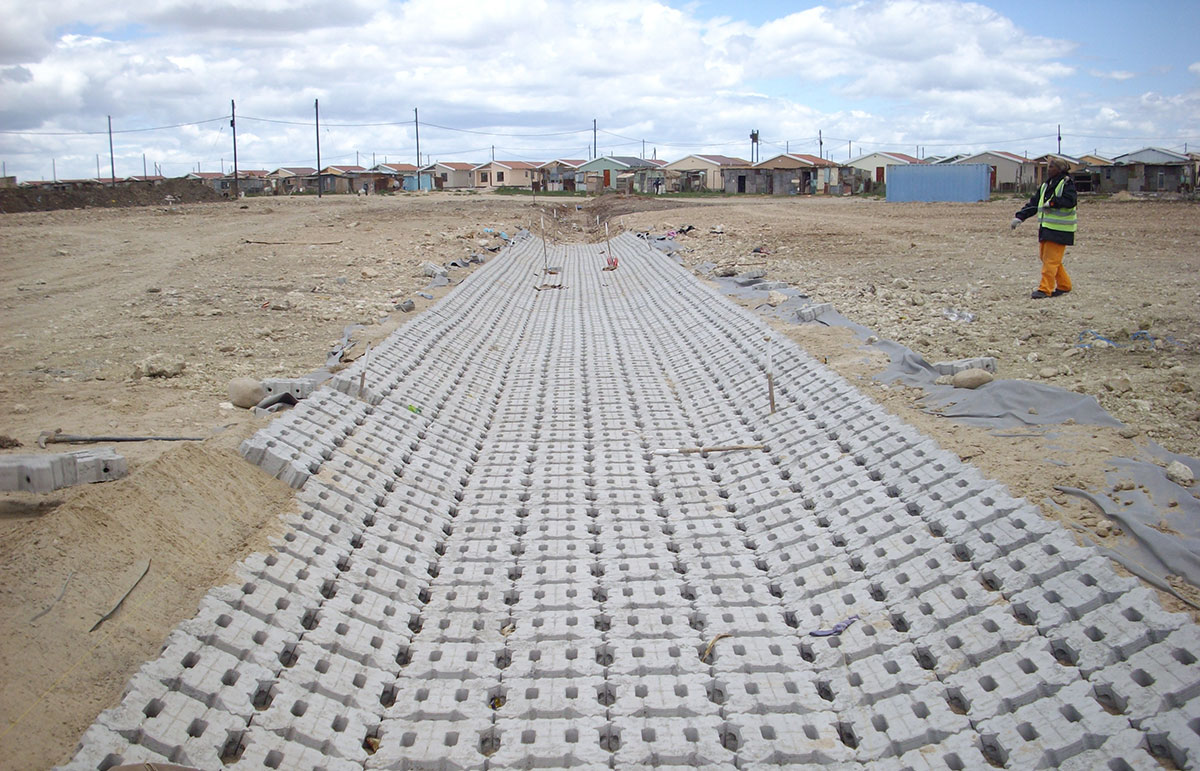


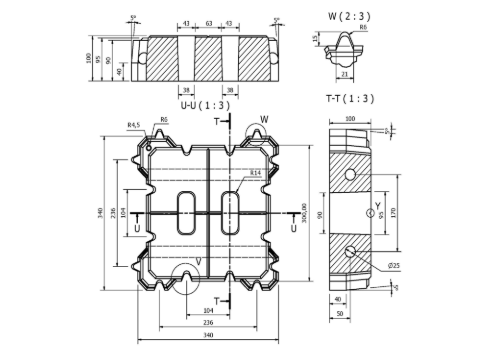

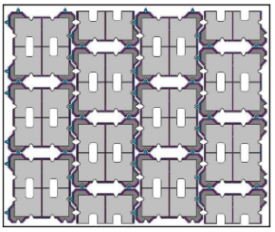
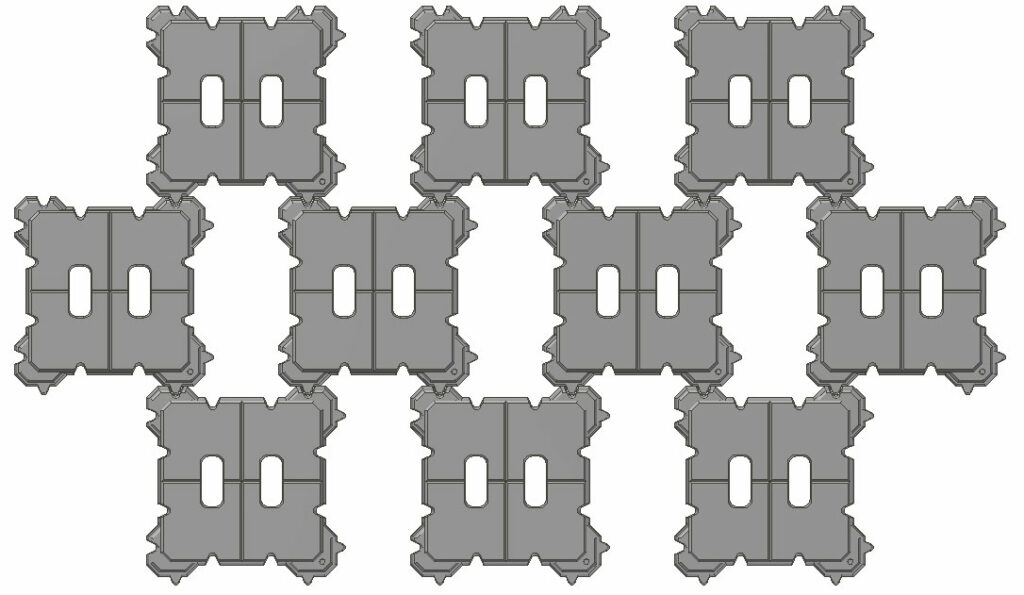

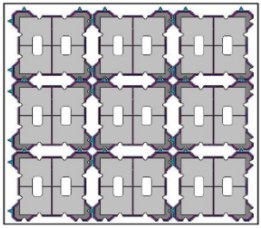
Please note when using the G8 Earthlock that it is advisable and usually necessary to use the services of a qualified engineer for the design of any type of water management, permanent and temporary road structures, parking areas, steep drive ways, erosion control and soil stabilizing.
The G8 Earthlock is manufactured as specified or required to either 25MPa or 35 MPa. The 35 MPa blocks are usually used for strip roads, permanent or temporary road structures, parking areas or where constant exposure to sea water occurs and where particular aggressive conditions are present.
Where both types of G8 Earthlock blocks are used on the same site great care must be taken not to mix the batches up.
Ground Preparation: The maximum performance of the G8 Earthlock relies on it’s ability to maintain intimate contact between the blocks, geotextiles and the base material. The G8 Earthlock guarantees intimate contact between the blocks and within the block matrix because of it’s all around interlocking ability. Thus the resistance to the shear forces between the blocks and within the block matrix are greatly increased. No other Hard Lawn Block block presently on the market has this feature.
Prior to laying the G8 Earthlock the base material must be profiled to line and level and compacted where necessary, with a compaction depth per layer of 200mm maximum and compaction density equal to the adjoining undisturbed soil, but not less then to within 5% of 95% standard Proctor density. Obstructions such as roots and projecting stones should be removed. Minor irregularities are accommodated by the flexible block matrix but if any block edge or corner of any individual block protrudes by more than 10mm above the surrounding blocks, such blocks should be leveled using a plate compactor, rubber mallet or other suitable equipment. In areas where settlement is expected to be severe due to extremely unstable foundation soil conditions steps should be taken to remove these soils and replace it with select material having proper stability. The natural angle of repose of the in situ material, when subjected to full hydraulic load conditions, must not be exceeded, unless the particular system has specifically been designed to allow for a steeper slope. When preparing the final shape of the ground, cognizance should be taken of the fact that the minimum vertical (concave) bending radii of the G8 Earthlock is approximately 1.0m. Immediately prior to placing the specified geotextile filter underlay, it is recommended that the project engineer inspects and approves the ground preparation.
If not specified by the project engineer, advice on the selection of a suitable geotextile filter material (underlay) should be obtained from a specialist. For heavy application Kaytech Bidim A4 has been used successfully. During the storage the geotextile filter material should be protected at all times from direct sunlight and should be kept in the protective covering until used. Care should be taken that the underlay is not damaged or torn before it’s used. If there is mechanical damage a patch with an overlap of at least 600mm in all directions may be used. Underlay should be placed directly onto the prepared and inspected surface area. When placing and joining the underlay longitudinally or transversely, care must be taken to ensure that overlaps between adjoining layers point into the direction of flow (i.e. the layer upstream of an adjoining layer should overlay the adjoining layer), and a minimum overlap of 500mm should be maintained. Staples may be used to secure the underlay from displacing before the blocks are placed.
Installation of the G8 Earthlock Hard Lawn Block: Because of the 4 sides interlocking mechanism of the G8 Earthlock it was necessary to provide a small round marker on the one corner top surface with the two male interlocking protrusions/nibs to help the installer to lay the blocks in the right direction at all times, thus saving valuable time.

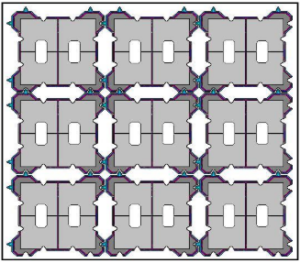
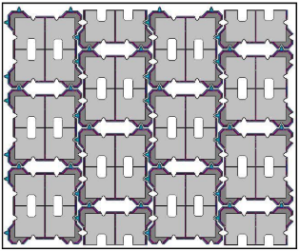
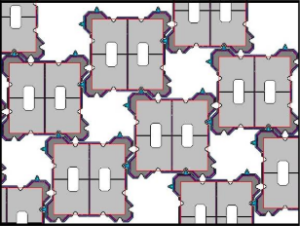
Although the blocks are self aligning when being installed, it is advisable, for all four possible laying patterns and for visual perfection, to use a line for a perfect block matrix. The G8 Earthlock are easy laced either with a 8 gauge galvanised wire, a 6 – 14mm polypropylene rope or a 3 – 6mm multi – strand stainless steel cable usually grade L316. The lacing is easily done through the precision aligned 25mm diameter holes. The G8 Earthlock can be laced in the standard lay out as well as in the close mesh lay out pattern. Unless otherwise specified, lacing should always be done in a direction perpendicular to the water flow or the traffic flow direction.
Gentle bends in the block matrix can be achieved by easing the outer edges. In the case of sharp bends blocks should either be cut or suitable concrete filling cast to fill the open gap between the two block faces shaping the change of direction.
On slopes greater than 1 : 2 the blocks may slide on the geotextile. Temporary or permanent anchorage can be achieved with steel pegs driven into the open cavities of the blocks and if permanent filled with a cement mix. Great care must be taken that the steel pegs are driven well below the top surface of the block (at least 50mm below the block top surface) and do not protrude above the block surface. The open areas of the G8 Earthlock should be filled with suitable materila or as specified by the project engineer. Suitable filler material is usually gravel, crusher dust, surrounding soil if suitable or fertile soil if to be planted.
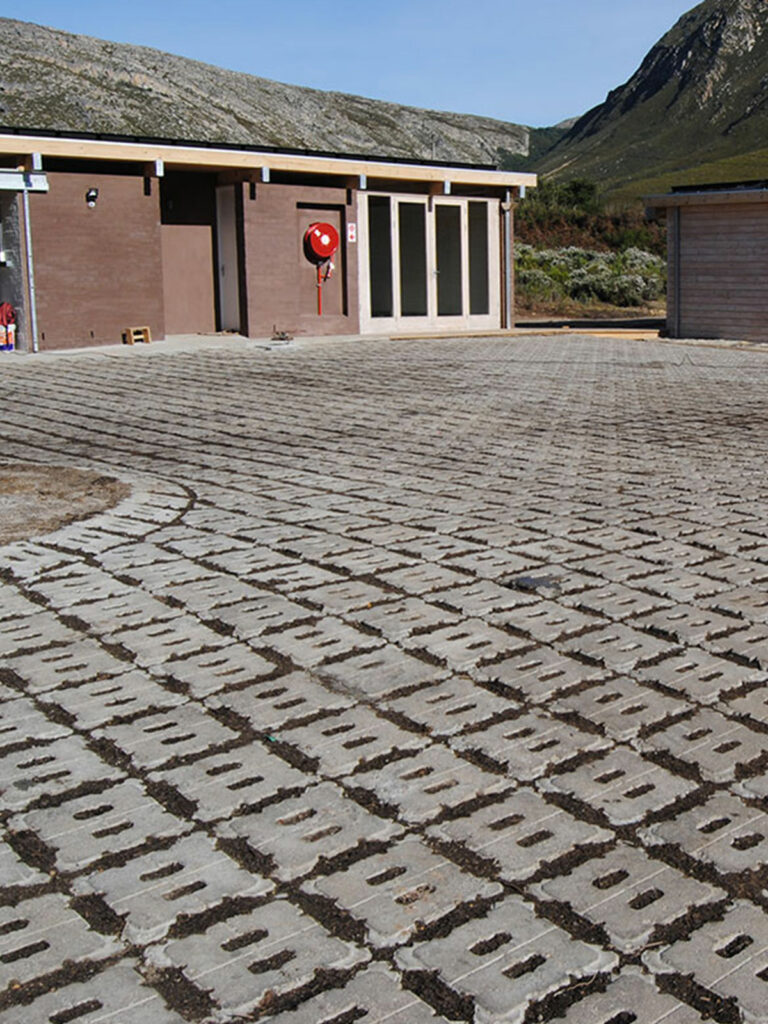
The applications of the G8 Earthlock is usually of a very specialized nature and therefor the services of an qualified engineer should be engaged. Once the G8 EarthLock matrix is installed, the covered area will through it’s regimental pattern, be aesthetically pleasing to the eye.